China's robot revolution in motion
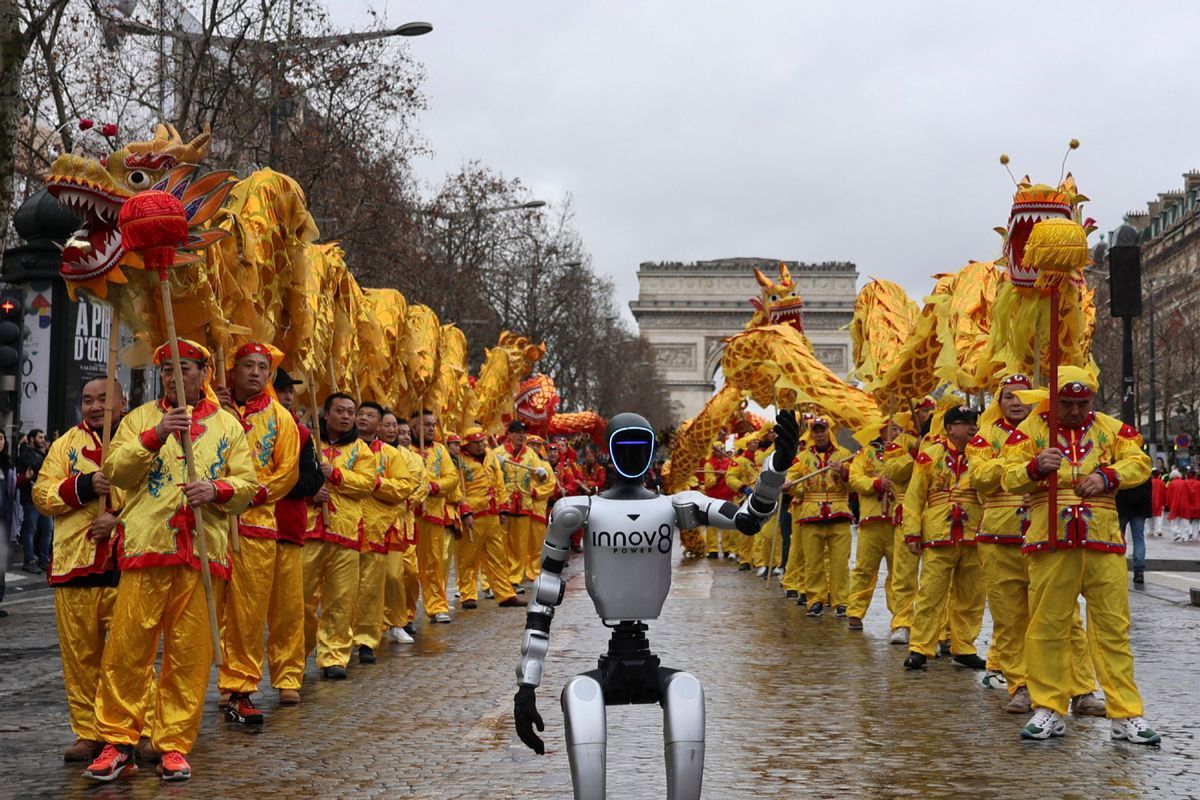
A humanoid robot leads a lion dance during a parade along the Champs-Elysees Avenue in Paris,日本47新闻网官网 France, blending tradition with technology ahead of the Chinese New Year.[Photo/Xinhua]
When Unitree's G1 humanoid robot executed a flawless 720-degree backflip on the stage of the Spring Festival Gala, it was easy to read the moment as spectacle. The somersault was crisp, the landing controlled, the applause immediate. Yet the performance signified something far more consequential than acrobatic novelty. It crystallized a broader transformation: China's deliberate evolution from the world's factory floor into a central architect of next-generation robotics.
Western headlines described the event as a "robotic revolution". But revolutions are, by nature, often chaotic. What is unfolding in China is neither spontaneous nor accidental. It is the cumulative result of strategic planning, vertically integrated supply chains, state-backed research ecosystems, and a cultural preference for applied experimentation over isolated theorizing.
Machines that think on their feet
The most visible expression of this shift is technological. In 2025, humanoid robots on public stages moved stiffly, executing preprogrammed folk dances with mechanical caution. By 2026, the G1 demonstrated fluid martial arts sequences—precise spins, controlled landings, and dynamic recoveries from imbalance. The difference was not merely aesthetic; it reflected a structural leap in embodied intelligence.
On paper, the hardware is formidable. The G1's joints deliver peak torques approaching 500 newton-meters, enabling explosive movement and stable recovery. Its carbon-fiber frame keeps total weight under 50 kilograms without sacrificing structural integrity. High-density batteries nearing 400 watt-hours per kilogram extend operational endurance while maintaining agility. These figures matter because they narrow the gap between mechanical output and human biomechanics.
But raw power alone does not produce grace. The decisive breakthrough lies in sensor fusion and adaptive control. Inertial measurement units, force sensors embedded in the feet and joints, and visual SLAM systems continuously update the robot's understanding of its posture and surroundings. During the televised backflip, observers noted a subtle knee adjustment on landing—a micro-correction executed in milliseconds. That tiny movement symbolized something larger: the ability of machines to respond autonomously to unpredictable physical conditions.
Even more telling was the synchronized choreography of more than fifty robots, operating with latency measured in mere milliseconds. Coordinating multi-agent systems at such speed requires distributed AI architectures capable of balancing centralized planning with decentralized execution. This is not simply about one robot performing well; it is about coordinated fleets acting in concert—an ability with implications that extend far beyond a gala stage.
From laboratory prototype to industrial ecosystem
Technological sophistication means little without industrial scalability. Here, China's advantage becomes structural.
The robotics sector benefits from an integrated supply chain that compresses development cycles and lowers costs. Domestic AI chipmakers, sensor manufacturers, and precision component suppliers operate in dense geographic clusters, particularly in provinces like Zhejiang and Guangdong. This proximity reduces procurement delays, accelerates iteration, and allows rapid refinement from prototype to production.
Cost competitiveness is equally critical. By leveraging mature manufacturing infrastructure and economies of scale, Chinese humanoid robots are often produced at significantly lower costs than their Western counterparts. This price differential does more than expand export potential; it accelerates domestic adoption across sectors.
China's robotics industry, now measured in the tens of billions of dollars, uses public demonstrations as high-intensity testing environments. Events such as the Spring Festival Gala function as real-world stress tests. Robots must navigate dynamic lighting, complex choreography, crowded backstage logistics, and live broadcasting pressures. Failures are visible; performance must be robust. This approach—testing systems in demanding, unscripted conditions—compresses the gap between research and deployment.
The results are visible in expanding applications. Humanoid and semi-humanoid systems are moving into eldercare facilities, logistics centers, and electric vehicle assembly lines. The same dynamic balance algorithms that enable a backflip also allow robots to traverse uneven terrain in disaster response or maintain stability while carrying loads on factory floors.
International expansion underscores this transition. Chinese robotics firms are increasingly active in European and Asian markets, supplying both hardware platforms and integrated solutions. As export shares rise, China is no longer merely assembling machines; it is shaping usage norms and technical expectations.
Competing models of innovation
The divergence between China and the West is not reducible to technical capability alone; it reflects contrasting innovation cultures.
Silicon Valley and European research institutions often prioritize incremental validation, extensive peer review, and controlled laboratory testing. This model excels in foundational breakthroughs and rigorous standardization. China, by contrast, has embraced scenario-driven innovation: deploy early, test under pressure, iterate rapidly. High-stakes public applications become catalysts rather than endpoints.
This difference has practical consequences. Dynamic balance, multi-agent coordination, and real-world adaptability are strengthened when systems confront messy environments rather than idealized lab conditions. Over time, such exposure compounds into durable capability advantages.
There is also a standards dimension. As Chinese robots proliferate in global markets, their communication protocols, operating architectures, and component interfaces may become de facto norms. Standards are not merely technical agreements; they embed influence. Control over ecosystems—software platforms, update pipelines and hardware compatibility—shapes long-term dependency structures.
In this sense, robotics becomes a contest of ecosystems. The question is no longer simply who builds better machines, but whose technological frameworks ultimately define the parameters of industrial automation and intelligent systems worldwide.
Beyond the stage: A technological civilization
The backflip was theater, but its longer arc points toward daily life. Aging demographics, labor shortages, and the demands of disaster resilience create structural incentives for humanoid deployment. Robots capable of navigating human environments—stairs, cluttered rooms, unpredictable surfaces—can complement existing automation beyond controlled settings.
China frames this expansion in terms of "human-machine harmony", envisioning robots not as replacements but as collaborators. There is also a philosophical undertone to this vision. Integrating advanced AI with cultural concepts of balance and systemic interdependence suggests an ambition to embed robotics within a broader social narrative, rather than treat it as purely another instrumental technology.
Whether that vision materializes remains uncertain. Ethical governance, labor displacement, and international trust will shape the trajectory. But the direction is unmistakable: robotics is no longer peripheral to China's development strategy. It sits at the intersection of industrial upgrading, demographic management, and global technological positioning.
The opening move
The 720-degree backflip was not an endpoint. It was a signal — a demonstration that China's robotics ecosystem has reached a threshold where power, intelligence and manufacturability converge. The performance condensed years of research, supply-chain coordination, and policy alignment into a few seconds of controlled rotation in midair.
If the past decades defined China as the workshop of the world, the coming era will test its capacity to become one of its principal engineers. In that unfolding contest, the choreography of machines on a holiday stage may prove to have been less a moment of entertainment than a quiet prologue.
(责任编辑:热点聚焦)
 为企业减负增效,外汇领域持续释放改革红利
 董洁宣布退出龙年春晚:更想陪家人过年
 轶清二楚|湖北的万亩烂漫山花,是谁栽种?
 汉川:小小爱心餐 满满高速情
 商务部:坚决反对欧盟对俄制裁列单中企和个人
-
伟星印江澜幼儿园的小朋友参与“百米纳福”活动2月13日,芜湖市中小学及幼儿园迎来新学期的开学日,学生们以崭新的面貌和饱满的热情开启了新一轮的学习生活。在各学校举行的开学典礼和“开学第一课”上,非遗文化 ...[详细]
-
 时值年尾,又到了一年一度盘点的时刻。今天呢,就来跟大家谈一谈过去这一年,在数字办公领域的一些变化。说实话,不同于手机、外设这种偏向于消费者的领域,在谈到数字办公时,我们总会有一个感觉,那就是“没有变化
...[详细]
时值年尾,又到了一年一度盘点的时刻。今天呢,就来跟大家谈一谈过去这一年,在数字办公领域的一些变化。说实话,不同于手机、外设这种偏向于消费者的领域,在谈到数字办公时,我们总会有一个感觉,那就是“没有变化
...[详细]
-
Valve 2024年度压轴大戏,《黑神话:悟空》狂揽三个Steam大奖
 《黑神话:悟空》虽遗憾错失TGA年度游戏,但人气居高不下。随着2024年Steam大奖公布,不出意外,《黑神话:悟空》一举拿下三个重要奖项,其中就包括2024 Steam年度游戏大奖。就在2024年最
...[详细]
《黑神话:悟空》虽遗憾错失TGA年度游戏,但人气居高不下。随着2024年Steam大奖公布,不出意外,《黑神话:悟空》一举拿下三个重要奖项,其中就包括2024 Steam年度游戏大奖。就在2024年最
...[详细]
-
 湖北日报讯记者刘畅、实习生殷金金)4月7日从武汉市新闻发布会上获悉,2025年,武汉市两级法院推动民生小案一次性高效执结,共执结涉民生、小标的案件4.06万件,执行到位6.39亿元。2025年,武汉全
...[详细]
湖北日报讯记者刘畅、实习生殷金金)4月7日从武汉市新闻发布会上获悉,2025年,武汉市两级法院推动民生小案一次性高效执结,共执结涉民生、小标的案件4.06万件,执行到位6.39亿元。2025年,武汉全
...[详细]
-
 size: 14px; line-height: 28px;">加力!外汇领域持续释放改革红利为企业减负增效,2025年外汇管理工作再提新举措!日前在京结束的2025年全国外汇管理工作会议上,国家外汇
...[详细]
size: 14px; line-height: 28px;">加力!外汇领域持续释放改革红利为企业减负增效,2025年外汇管理工作再提新举措!日前在京结束的2025年全国外汇管理工作会议上,国家外汇
...[详细]
-
 本报讯“走,我们到图书室看书去!”这是春节前后凤阳县红心镇梅市社区的孩子们最喜欢说的一句话。寒假期间,梅市社区文化乐园图书阅览室热闹非凡,每天都挤满了前来看书的孩子。这里的书架上整齐地摆放着各类书籍,
...[详细]
本报讯“走,我们到图书室看书去!”这是春节前后凤阳县红心镇梅市社区的孩子们最喜欢说的一句话。寒假期间,梅市社区文化乐园图书阅览室热闹非凡,每天都挤满了前来看书的孩子。这里的书架上整齐地摆放着各类书籍,
...[详细]
-
 2月11日,演员在安徽省亳州市魏武广场天幕剧场表演梆剧《秦香莲后传》。当日,安徽省亳州市谯城区开展文化惠民戏曲精品剧目展演活动,让广大市民在家门口看大戏,活动将持续到2月20日。新华社发刘勤利 摄)[
...[详细]
2月11日,演员在安徽省亳州市魏武广场天幕剧场表演梆剧《秦香莲后传》。当日,安徽省亳州市谯城区开展文化惠民戏曲精品剧目展演活动,让广大市民在家门口看大戏,活动将持续到2月20日。新华社发刘勤利 摄)[
...[详细]
-
 虽然华为纯血鸿蒙系统已经上线,大部分应用完成了原生鸿蒙开发,但是依然有不少应用尚不能在纯血鸿蒙系统上使用,其中以游戏偏多,包括腾讯系游戏。继《王者荣耀》完成纯血鸿蒙系统适配之后,《和平精英》也正式拥抱
...[详细]
虽然华为纯血鸿蒙系统已经上线,大部分应用完成了原生鸿蒙开发,但是依然有不少应用尚不能在纯血鸿蒙系统上使用,其中以游戏偏多,包括腾讯系游戏。继《王者荣耀》完成纯血鸿蒙系统适配之后,《和平精英》也正式拥抱
...[详细]
-
由中央广播电视总台、自然资源部、国家林业和草原局联合摄制的两集系列片《丹霞山》,将于5月21日起在央视综合频道CCTV-1)18:20档《自然中国》栏目播出,央视频全网首播。“色如渥丹,灿若明霞”,在 ...[详细]
-
 天娱传媒旗下艺人曾轶可庆功改版专辑《羽绒服》于11月18日全面发行上市。因曾轶可今年暑期发行的原创专辑《一只猫的旅行》,从前期预售到正式发行,创下不俗的成绩,销量口碑双双告捷,因此经纪公司天娱传媒在深
...[详细]
天娱传媒旗下艺人曾轶可庆功改版专辑《羽绒服》于11月18日全面发行上市。因曾轶可今年暑期发行的原创专辑《一只猫的旅行》,从前期预售到正式发行,创下不俗的成绩,销量口碑双双告捷,因此经纪公司天娱传媒在深
...[详细]